Tank level monitoring solution
Modern enterprises that manage liquid storage — from fuel to water — face the critical need for continuous tank level monitoring and infrastructure status control. Poor monitoring can lead to leaks, equipment downtime, and higher operational costs. In this context, IoT-powered solutions become essential for digital transformation. The IoT Hub IoT platform addresses these challenges with ease.
The IoT Hub platform offers a comprehensive approach to tank level monitoring, enabling real-time tracking of key metrics such as volume, temperature, sensor battery level, and connectivity status. Thanks to its flexibility, IoT Hub can be easily tailored to meet industry-specific needs, whether for small-scale or enterprise-wide deployments.
IoT Hub stands out due to its scalability, support for multiple protocols (MQTT, HTTP, CoAP, and others), customizable dashboards, and robust device management tools. It empowers users to deploy both local and cloud-based solutions that effectively monitor dispersed tank networks at any scale.

Solution structure of tank level monitoring
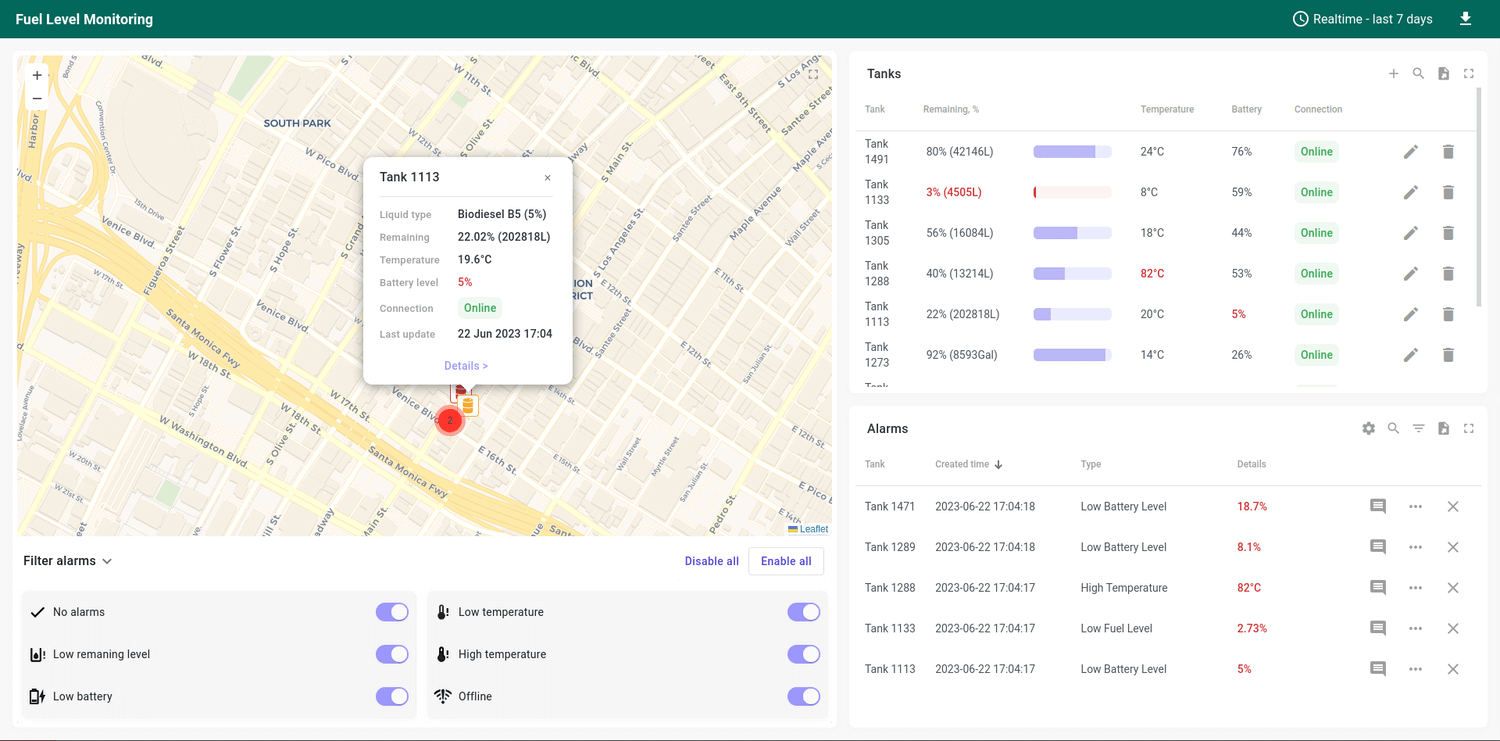
The tank level monitoring solution integrates IoT sensors — such as level, temperature, and battery — with the IoT Hub platform. Data is transmitted via standard protocols: MQTT for real-time telemetry, HTTP for periodic updates, and CoAP for low-power environments. This ensures reliable, efficient communication across a wide range of devices and conditions.
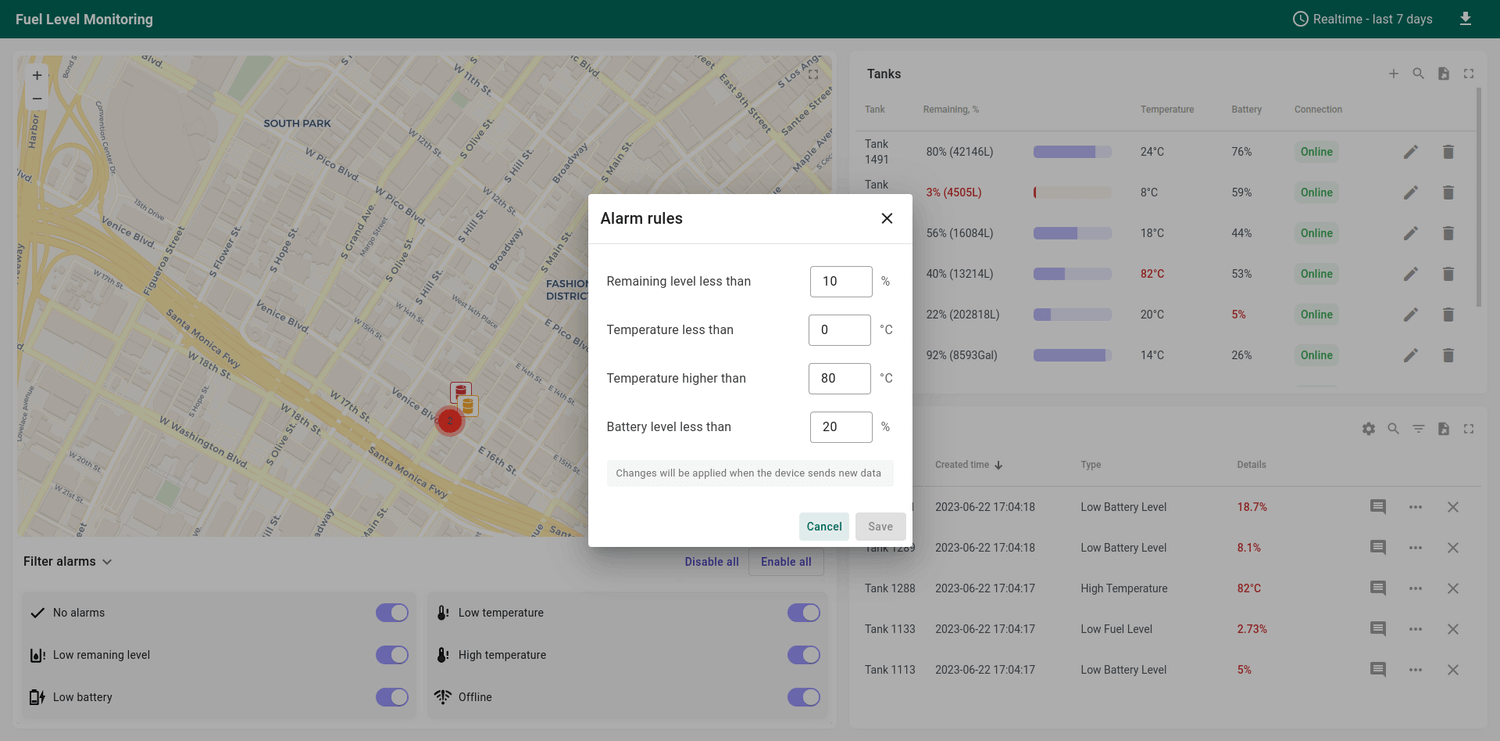
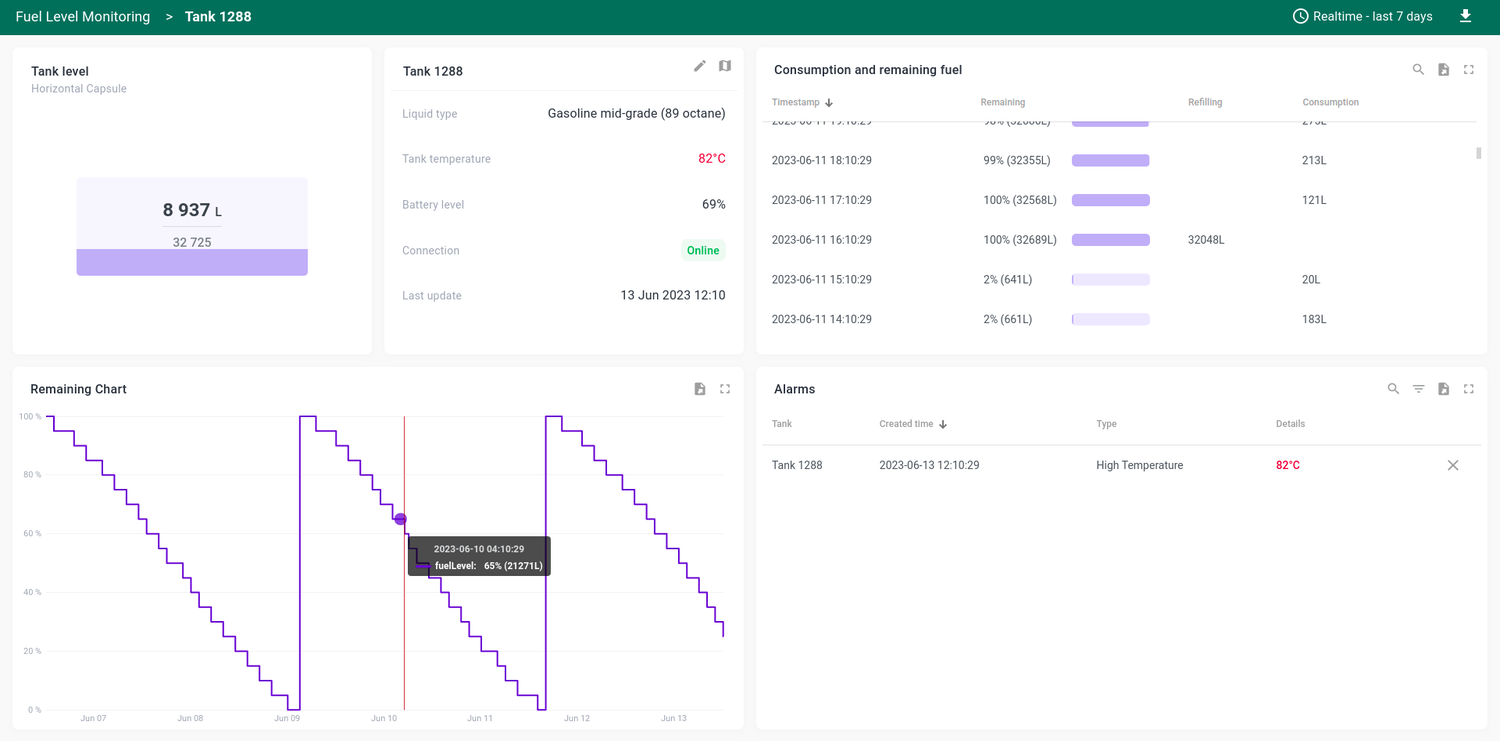
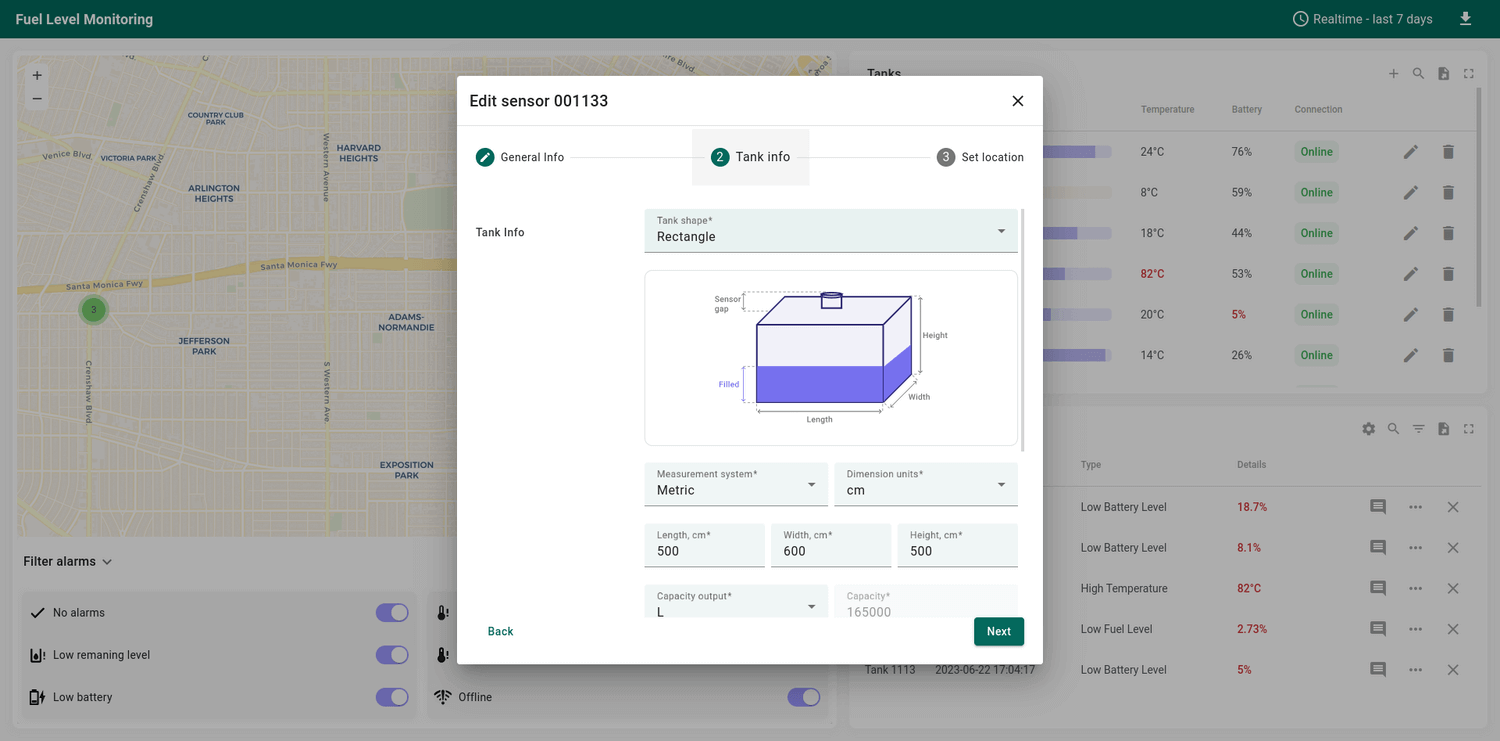
Once collected, the data is transmitted to IoT Hub for processing, aggregation, and visualization. The platform offers historical data storage, advanced alarm rule configuration, and remote device management. Incoming data is presented through interactive dashboards that display all metrics in user-friendly formats: graphs, maps, tables, and status widgets.
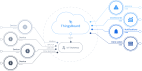
Tank level monitoring dashboard structure
The dashboards in IoT Hub are modular: each panel is a self-contained widget that retrieves data from a specific device or group. They support drill-down navigation, filtering, and grouping by fuel type or region. This makes the interface intuitive and easy to scale for large deployments.
Applications of tank level monitoring solution
IoT Hub's Tank Level Monitoring Solution is adaptable across a wide range of industries, addressing their specific needs:
Oil & gas
Enables remote monitoring of fuel tanks with automated alarms and minimal maintenance requirements.
Agriculture
Tracks water or fertilizer tank levels on farms, with location-based analysis and consumption forecasting.
Municipal services
Manages city tanks for drinking water or chemicals with centralized monitoring and regulatory reporting.
Logistics & transportation
Tracks fuel levels in fleet tankers and depots, integrated with GPS and routing systems.
Manufacturing & processing
Monitors chemical storage tanks for compliance and safety in industrial environments.
Oil & gas
Enables remote monitoring of fuel tanks with automated alarms and minimal maintenance requirements.
Logistics & transportation
Tracks fuel levels in fleet tankers and depots, integrated with GPS and routing systems.
Agriculture
Tracks water or fertilizer tank levels on farms, with location-based analysis and consumption forecasting.
Manufacturing & processing
Monitors chemical storage tanks for compliance and safety in industrial environments.
Municipal services
Manages city tanks for drinking water or chemicals with centralized monitoring and regulatory reporting.
Summary of tank level monitoring
The ThingsBoard-based tank level monitoring solution automates fluid storage monitoring for any scale or complexity. With strong support for industrial protocols, real-time visualization, rule-based alarming, and device control, it is a perfect fit for B2B enterprises, public infrastructure, and industrial environments. Enhanced transparency and timely alarms lead to improved operational efficiency and reduced costs.

IoT Hub advantages
 Security
IoT Hub protects your data with industry-standard encryption algorithms like RSA and ECDSA. Secure communication is ensured via TLS (TCP) and DTLS (UDP). Role-based access control and audit logs further enhance platform security.
 Data visualization
Visualize data with interactive, multi-state dashboards—no coding needed. Use built-in charts, gauges, maps, tables, and control widgets. Customize every detail via advanced settings or custom widget bundles. Real-time, low-latency updates supported via embedded web-sockets.
 Connectivity
Connect devices directly to the platform via the following built-in protocols: HTTP, CoAP, MQTT, LwM2M, and SNMP. Connect devices in your local network to the cloud using IoT Hub Gateway via Modbus, BLE, BACnet, OPC-UA, and other protocols.
 Data processing
IoT Hub allows you to define app logic using a drag-and-drop rule chain designer. Its scalable Rule Engine uses message queues like Kafka or AWS SQS for durable, reliable data processing. You can handle data within the engine or forward it to external systems.
 Scalability and high availability
IoT Hub supports high-availability cloud and on-prem deployments via Kubernetes or bare-metal. Its components scale horizontally and handle 18K+ vehicles and 5K+ devices in prod.
 Multi-tenancy
IoT Hub provides UI and API to manage tenants, customers, users, devices, and assets. Single tenant may have multiple tenant administrators and millions of devices and customers. It also offers out-of-the-box support of OTA updates for your smart meters.

